

Why Small Professional Firms are Prime Targets for Opportunistic Attacks
There’s a common misconception among business owners that cybercriminals are like assassins — carefully choosing high-value targets, executing complex plans, and disappearing without a trace. The truth is much less cinematic.
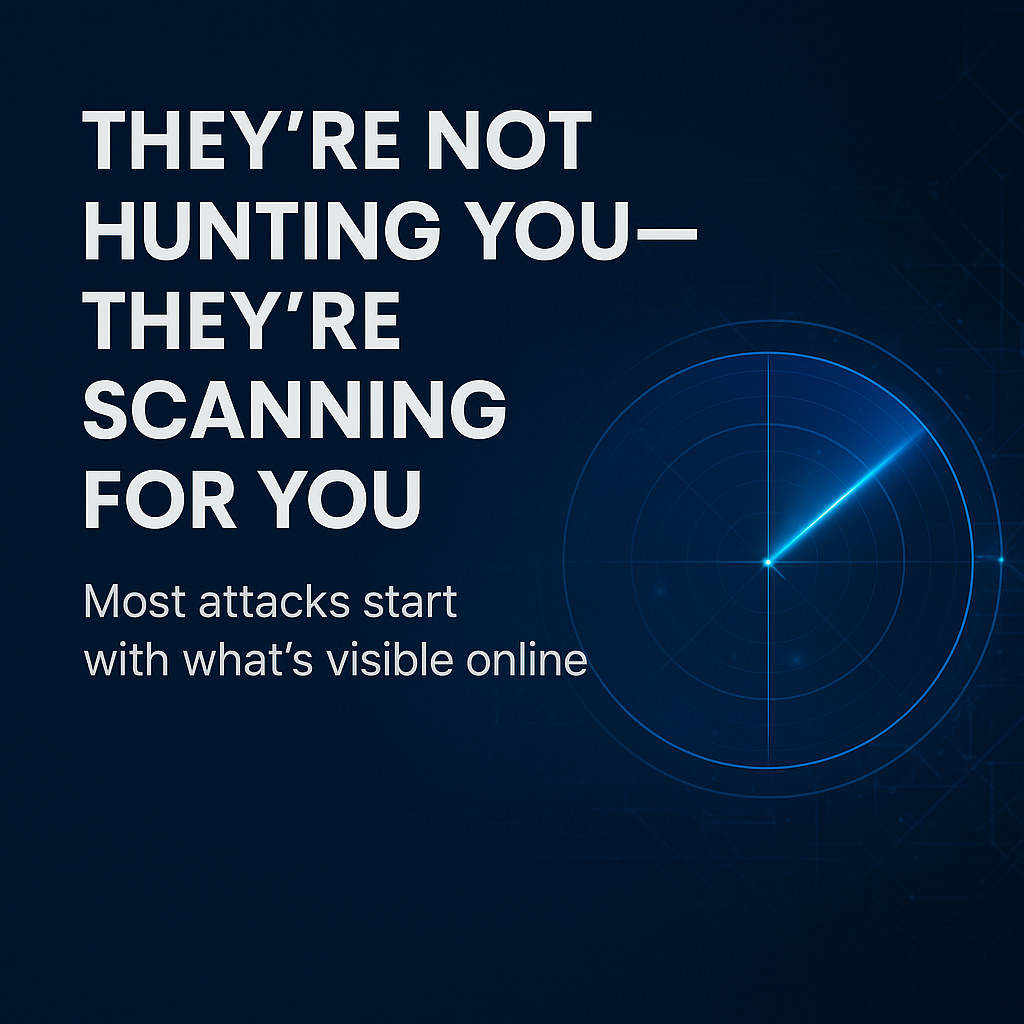
Most cyberattacks today aren’t targeted at all. They’re automated. Hackers and bots continuously scan the internet looking for the easiest way in — an exposed login, a forgotten server, or an outdated remote access tool left running in the background. When they find an opening, they don’t stop to ask what kind of business it is. They exploit it, encrypt it, and move on.
For many professional services firms — law practices, engineering groups, architecture firms, marketing agencies, and consultancies — this means you can become a victim simply because your systems are visible online.
The Invisible Beacon You Didn’t Know You Had
Every business connected to the internet emits a kind of “digital beacon.” Think of it like the light that spills through your office windows at night — you might not notice it, but to someone outside, it’s clear that the building is occupied.
Technologies such as remote desktop tools, VPN logins, and email servers are often left exposed and unprotected, creating bright, blinking signs for attackers saying, “This door might be open.” Cybercriminals use automated scanners to search for these vulnerabilities 24/7. When they find an unprotected system, they test it — just like a thief trying doorknobs on a quiet street.
What Makes Professional Service Firms Especially Vulnerable
Firms in the professional services sector hold the exact kind of information criminals can quickly monetize: client data, contracts, plans, proprietary designs, financial records, and privileged communications.
Yet, most small and midsize firms rely on outside IT providers without regularly auditing configurations; use remote access tools for convenience that were never meant to be open to the public internet; and assume their data isn’t valuable enough to target. The combination of valuable data and under-protected systems creates the perfect target for opportunistic cybercriminals.
How Hackers “Find” You
Attackers don’t need to know your firm’s name to find your vulnerabilities. They use tools that scan every IP address on the internet, searching for known systems with specific characteristics — an exposed remote desktop port here, an unpatched VPN panel there. If your system responds, it’s added to a list. From there, attackers attempt to force their way in using weak or stolen credentials, or exploit known software flaws. They don’t care what kind of business you run. They care that you’re easy to access.
What a Risk Assessment Reveals
Cyber insurance carriers like Coalition perform a similar type of scanning when evaluating businesses for coverage. If they can see an exposed technology during an assessment, so can cybercriminals. For business owners, these assessments aren’t just about insurance eligibility — they’re one of the fastest ways to identify the vulnerabilities that are putting your firm at risk. It’s the digital equivalent of discovering the back door has been unlocked for months.
Simple Steps to Protect Your Firm
- Eliminate unnecessary internet-facing systems.
- Require multi-factor authentication (MFA) for every remote login or email account.
- Keep all software patched and updated.
- Ask your IT provider for a “vulnerability and exposure report.”
- Work with a broker or risk advisor who understands cyber risk.
The Bottom Line
Cybercriminals don’t care who you are — only how easy you are to breach. By closing the obvious gaps, your firm moves out of the “easy target” category and into the “too much work” pile that attackers skip over. If you’re not using it, or if it doesn’t need to be public… get it off the internet.