
Why this coverage category confuses people
Environmental liability insurance is not a single product, and that’s one of the first things buyers need to understand.
The goal isn’t to buy environmental coverage in the abstract. The goal is to match the policy form to the way the exposure actually shows up in the business.
SSPL: coverage tied to a location
Site-specific pollution liability, or SSPL, is designed for contamination tied to a particular premises. This is the form people often look at when the risk is connected to a building, facility, warehouse, or owned site.
In plain English, SSPL is for businesses whose environmental exposure is tied to a place.
CPL: coverage tied to contracting operations
Contractors pollution liability, or CPL, is built for operations rather than one fixed premises. It follows the contractor’s work and is designed for pollution events arising out of jobsite activities, including completed operations in many cases.
In plain English, CPL is for businesses whose environmental exposure moves from project to project.
STP and TPL: more specialized forms
Storage tank pollution liability, or STP, is designed for contamination tied to underground or aboveground tanks. Transportation pollution liability, or TPL, addresses pollution connected to loading, unloading, and transit.
These forms matter because some businesses assume another policy will pick up the exposure when it really may not.
Why the distinction matters
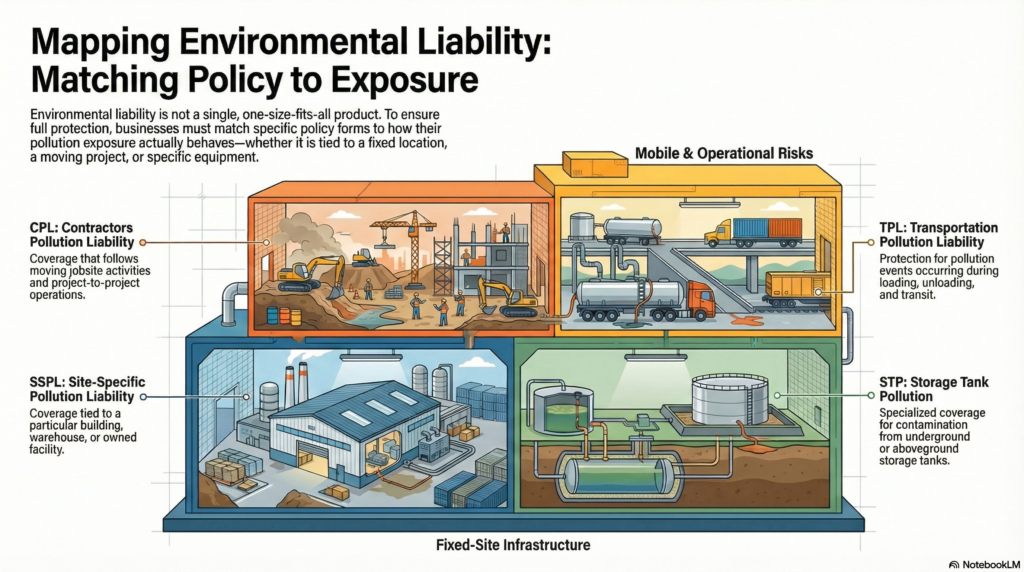
A lot of businesses don’t need just one environmental form. They may need a combination depending on whether the exposure is tied to a site, operations, tanks, transportation, or all of the above.
That’s why this isn’t a one-size-fits-all decision. The right form depends on how the risk actually behaves in the real world.