


The issue is not simply whether employees are being paid. The issue is whether the business can prove they are being paid correctly.
Wage and hour compliance is often viewed as an HR or payroll issue. But when something goes wrong, the financial impact lands squarely on the business.
Back wages, penalties, legal fees, employee disputes, regulatory scrutiny, and reputational damage can all flow from payroll practices that seemed routine at the time. For CFOs, wage and hour compliance should be treated as part of the company’s broader risk management strategy.
The issue is not simply whether employees are being paid. The issue is whether the business can prove they are being paid correctly.
Why Wage and Hour Risk Is Easy to Underestimate
Many wage and hour problems do not begin with obvious misconduct. They often begin with small process gaps.
An employee answers emails after clocking out. A supervisor tells someone to “just finish up quickly” before recording time. A worker is treated as an independent contractor because that arrangement feels simpler. Overtime is calculated incorrectly. Time records are incomplete. Meal breaks are not documented consistently.
Individually, these may look like small issues. Over time, they can become expensive.
The Department of Labor’s Wage and Hour Division can review up to three years of wage and hour records when evaluating an employer’s payroll practices. Recent case studies show costly violations involving overtime failures, off-the-clock work, worker misclassification, and inaccurate records.
The Four Common Failure Points
Worker Classification:
Misclassifying employees as independent contractors can create serious exposure. The label used by the employer is not enough. Regulators look at the actual working relationship. If a worker is economically dependent on the business, performs work central to the business, and does not truly operate independently, contractor classification may be challenged.
Overtime Calculation:
The Fair Labor Standards Act generally requires covered, nonexempt employees to receive overtime at 1.5 times their regular rate of pay for hours worked over 40 in a workweek. Mistakes can occur when businesses average hours across weeks, fail to include certain compensation in the regular rate, or overlook overtime triggered by off-the-clock work.
The issue is not simply whether employees are being paid. The issue is whether the business can prove they are being paid correctly.
Off-the-Clock Work:
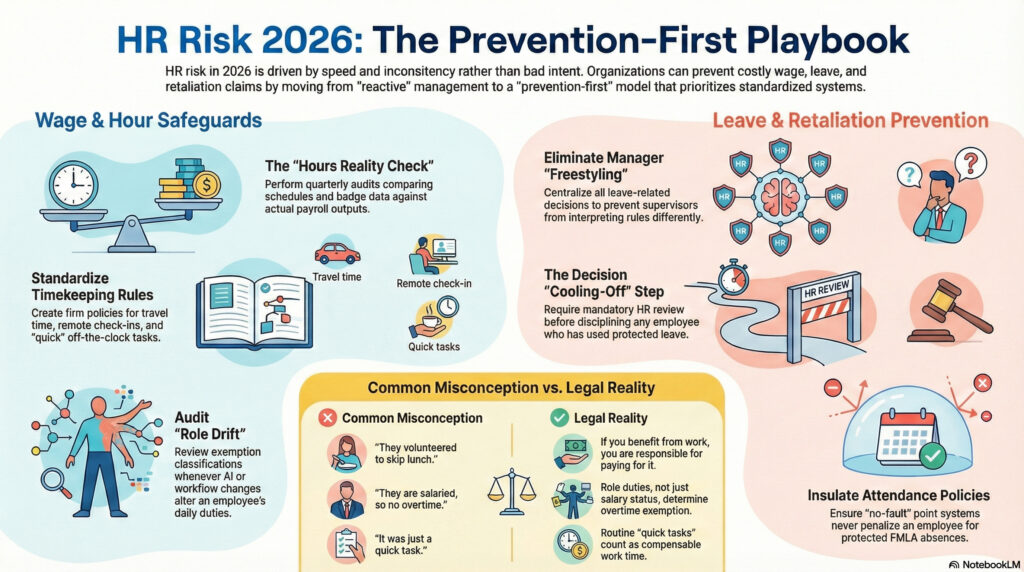
If an employer knows or has reason to know work is being performed, that time may be compensable. This can include work before or after shifts, missed meal periods, administrative tasks, travel-related work, or remote work outside normal hours.
Recordkeeping:
Better documentation leads to better outcomes. Weak records can make it difficult to defend the business, even if leadership believes employees were paid properly. For CFOs, poor records shift the conversation from facts to assumptions. And assumptions rarely help during a regulatory review or employee dispute.
What CFOs Should Do Next
A practical wage and hour risk review should include:
- Reviewing employee vs. contractor classifications
- Auditing exempt vs. nonexempt status
- Testing overtime calculations
- Reviewing timekeeping procedures
- Confirming how off-the-clock work is prevented and reported
- Training supervisors on compensable time
- Reviewing record retention practices
- Documenting corrective action
This does not need to be a massive project. It can start with a targeted internal audit of the highest-risk employee groups or a complementary FLSA Compliance Assessment.
How This Affects Insurance
Wage and hour claims are not always covered by insurance. Employment practices liability policies may provide some defense or limited coverage depending on the wording, endorsements, exclusions, and jurisdiction, but wage and hour exposures are often specifically excluded.
That means prevention matters.
Insurance should be part of a broader risk strategy, but it should not be the first line of defense against payroll noncompliance. Proactive CFOs know that strong processes, accurate records, and regular audits are the most reliable protection.
Conclusion
Wage and hour compliance is a financial control issue. It affects cash flow, reserves, employee trust, regulatory exposure, and the total cost of risk.
The businesses that manage this well are not simply trying to avoid penalties. They are building more predictable operations.
Stillwell Risk Partners helps businesses think through employment-related risk, coverage limitations, documentation practices, and prevention-first strategies that reduce the likelihood of costly surprises.