
Most manufacturing leaders do not set out to create a safety program that hides injuries, discourages reporting, or gives management a false sense of control. But that is exactly what can happen when a well-intentioned initiative is built around the wrong incentive, the wrong metric, or the wrong managerial pressure.
The result is dangerous because the organization starts to look safer on paper at the exact moment its operational risk is becoming harder to see. In our experience, this is one of the clearest examples of the principle that good intentions alone do not produce good outcomes. In safety, design matters. Incentives matter. Culture matters.
Below are five real-world examples manufacturing leaders should understand, along with the lesson each one offers.
1. Low injury counts can hide serious operational exposure
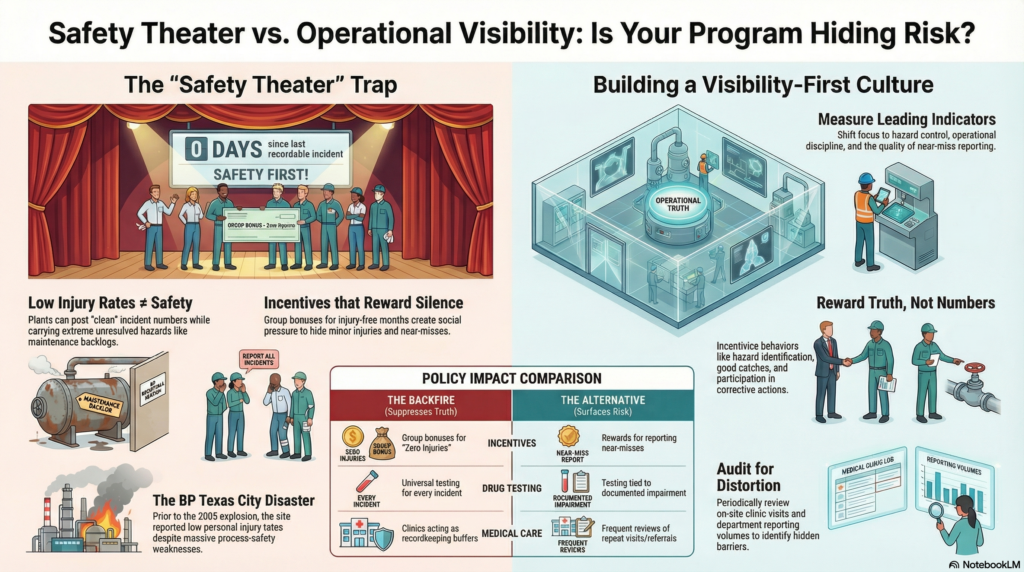
BP’s Texas City refinery disaster remains one of the strongest examples of why injury statistics alone can be misleading. Prior to the 2005 explosion, the site had a low personal injury rate, yet major process-safety weaknesses had been building beneath the surface. Leadership had numbers that suggested progress, while the operation itself contained severe unresolved hazards.
Manufacturing leaders should take the same warning seriously. A plant can post an acceptable incident rate while still carrying major lockout/tagout, maintenance, machine-guarding, dust, chemical, or line-speed exposure. If the dashboard mainly tells you how many injuries were reported, but tells you little about uncorrected hazards, overdue maintenance, near-miss quality, or recurring root causes, the dashboard may be comforting you more than it is protecting you.
2. Rate-based incentives often suppress the truth
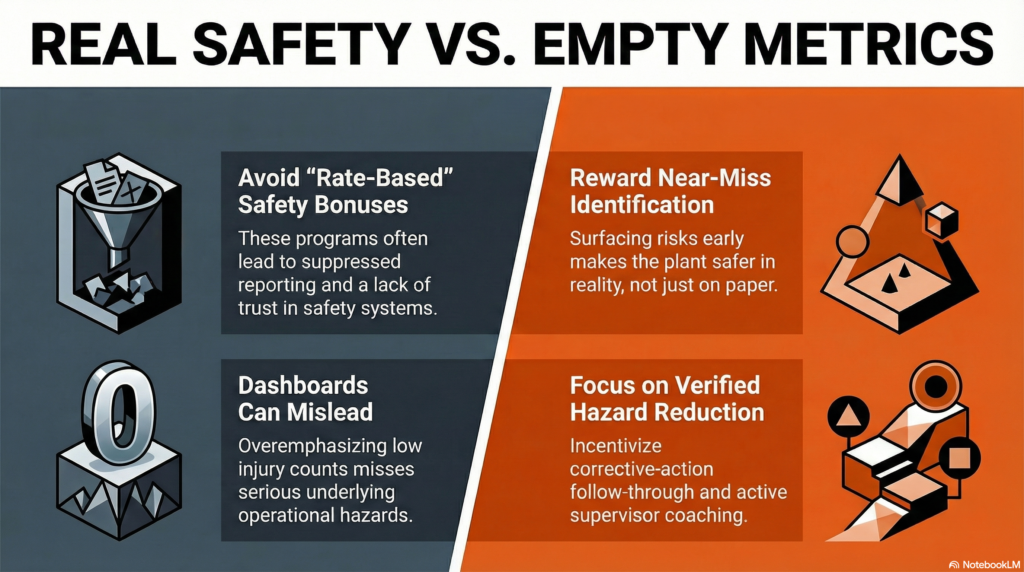
Group bonuses for injury-free months or quarters are usually introduced with positive intent. Management wants to reward safe performance, create team accountability, and build momentum. The problem is that these programs often reward silence more effectively than they reward prevention.
When one reported injury costs the whole team its bonus, lunch, or celebration, workers quickly understand the social pressure built into the system. A cut gets bandaged quietly. A strain goes unreported. A near miss never gets documented. Over time, leadership sees better numbers and less useful information.
A stronger alternative is to reward the behaviors that improve visibility: near-miss reporting, corrective-action follow-through, participation in hazard identification, and good catches that prevent a larger loss.
3. Blanket post-incident drug testing can make reporting feel risky
Post-incident drug testing is often defended as a way to promote discipline and deter unsafe behavior. In some situations, it may be appropriate. But when every reported incident automatically triggers testing, the policy can shift from a safety tool to a reporting deterrent.
That design creates a simple internal calculation for employees: report the injury and invite scrutiny, or stay quiet and avoid the hassle. In manufacturing environments, where smaller symptoms often point to larger ergonomic, procedural, or equipment-related problems, that silence can be costly. The case that never gets reported is often the clue that never gets investigated.
A better policy connects testing to a documented reason to believe impairment contributed to the event, rather than using testing as a universal consequence for speaking up.
4. On-site clinics can become recordkeeping buffers
On-site clinics and nurse stations can be valuable. Faster response, easier access to care, and immediate triage all sound like responsible investments. But in some industrial settings, these systems have been criticized for becoming informal filters that absorb repeat complaints, delay outside treatment, and keep more serious cases from being recognized early.
That creates a dangerous disconnect. The organization can tell itself it is responding quickly, while the same worker returns again and again with the same unresolved problem. At that point, the issue is no longer just medical. It is operational.
Manufacturers should periodically review repeat clinic visits, delayed referrals, and patterns tied to specific departments, job functions, or supervisors. If the same problems keep reappearing, the clinic may be managing symptoms while the plant keeps producing causes.
OSHA’s 2016 “Improve Tracking of Workplace Injuries and Illnesses” rule (29 CFR §1904.35) addressed this concern broadly, targeting employer programs and policies that, while nominally promoting safety, have the effect of discouraging workers from reporting injuries and leading to incomplete or inaccurate records of workplace hazards (U.S. Department of Labor). On-site clinics that function as informal filters fall squarely within the category of systems OSHA considers inconsistent with accurate recordkeeping obligations.
5. Reporting systems fail when workers fear retaliation
A hotline, anonymous form, or open-door policy only works if employees trust the system. Once workers conclude that reporting a hazard, requesting PPE, or raising a concern makes them look disloyal or difficult, the reporting structure loses its real value.
This is where many organizations misunderstand safety culture. They think the presence of a reporting channel proves openness. It does not. The real test is whether employees use the system early, often, and without hesitation.
Manufacturers should pay close attention to whether certain supervisors, departments, or shifts show unusually low reporting volume. In some cases, low reporting is not a sign of strong performance. It is a sign that people have learned to keep bad news to themselves.
What manufacturers should do instead
The most effective safety programs are not built to protect a number. They are built to surface risk quickly, investigate it honestly, and remove it before it becomes a claim, loss, or catastrophe. That means:
- measuring leading indicators tied to hazard control and operational discipline
- rewarding reporting instead of suppressing it
- training supervisors to respond constructively when issues are raised
- auditing whether medical, incentive, and disciplinary systems are distorting the truth
- treating safety culture as a reporting environment, not a slogan
A program that reduces reported injuries by making employees less likely to speak up is not improving safety. It is only reducing visibility.
Real Impact to Your Bottom Line
Manufacturers do not need more safety theater. They need systems that tell the truth early enough to matter. The right safety structure does not just reduce claims. It improves trust, operational awareness, and management decision-making.
If your current safety program is producing clean numbers but weak visibility, it may be time to take a harder look at what the program is actually encouraging.
Ready to Take Action?
Want a second set of eyes on whether your safety program is surfacing risk or suppressing it? Stillwell Risk Partners helps manufacturers identify hidden reporting barriers, incentive problems, and operational blind spots before they become larger losses.