

Benefits of a Workplace Safety Committee
So you’re thinking about setting up a Workplace Safety Committee.
There are generally two reasons businesses set up a safety committee, and they’re not mutually exclusive:
- Cost Savings: The Safety Committee Credit in Pennsylvania provides a mandatory 5% premium credit on your Workers Comp policy – regardless of who your insurance carrier is.
I mention the Pennsylvania credit here, but even if you’re not in Pennsylvania, the cost savings from a well-run safety committee can make this credit comparably small. - Injury Prevention: When implemented properly, a safety committee will have a positive impact on both the frequency and severity of injuries that occur in your workplace.
The reason these are not mutually exclusive is because if set up properly, the safety committee will very likely prevent injuries and provide your company with a broader range of cost savings than simply those available on your Workers Comp policy.
The unfortunate reality is that the mere existence of a safety committee will not prevent accidents. If the committee is not taken seriously – or if committee members and/or employees don’t see any tangible impact – it’s unlikely the committee would have any meaningful impact.
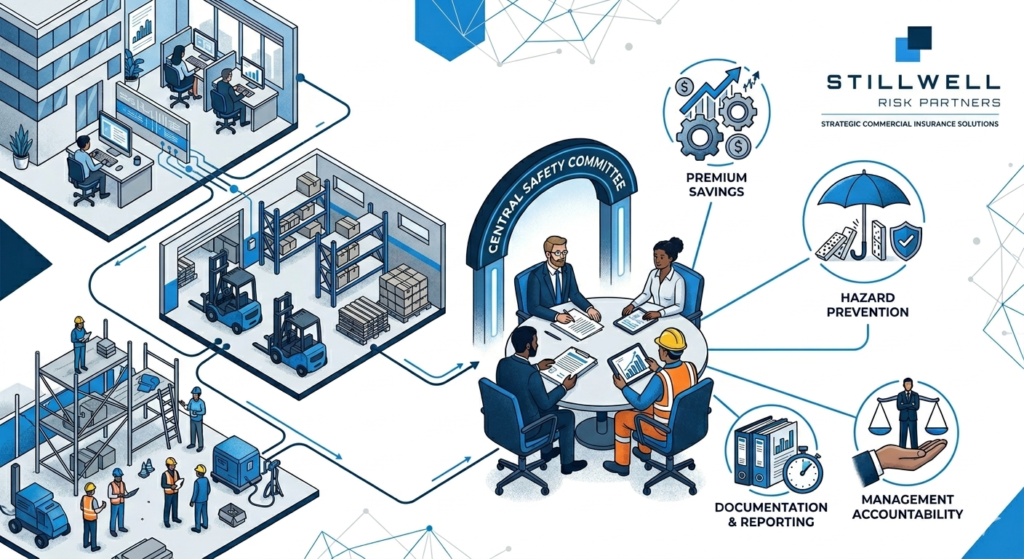
The 5% premium credit is valuable, but the larger opportunity is using the safety committee as a repeatable operating system for identifying hazards, correcting issues, documenting improvement, and proving to underwriters that the business manages risk better than average.
Short- and Long-Term Benefits
The short-term benefit is the 5% credit. There’s a minimum timeline for qualifying for the credit which includes 6 months of documented meetings and processes, then applying within the right window to qualify for the credit (30 – 90 days prior to your policy’s renewal date for the initial application).
Here’s the process at a glance:
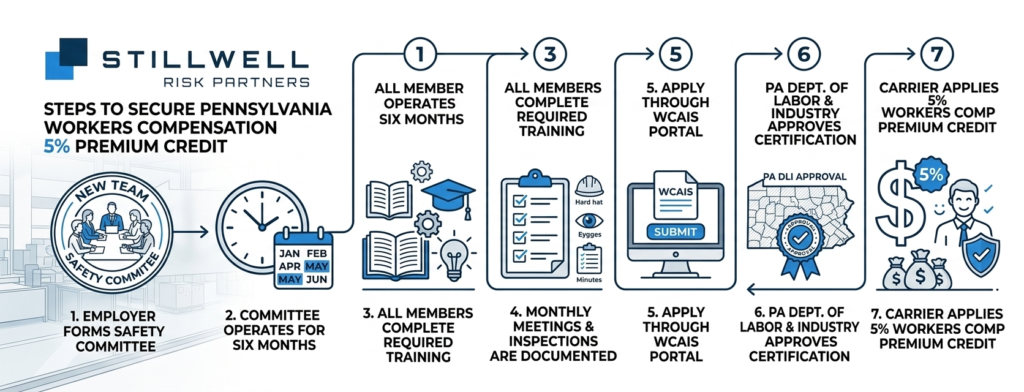
The minimum time for being ready to apply for the credit is 6 months. Depending on when you start, you might not see the credit on your policy for 1-2 years. In other words, the true short-term benefits are very limited, but you might be able to see some premium impact in less than a year.
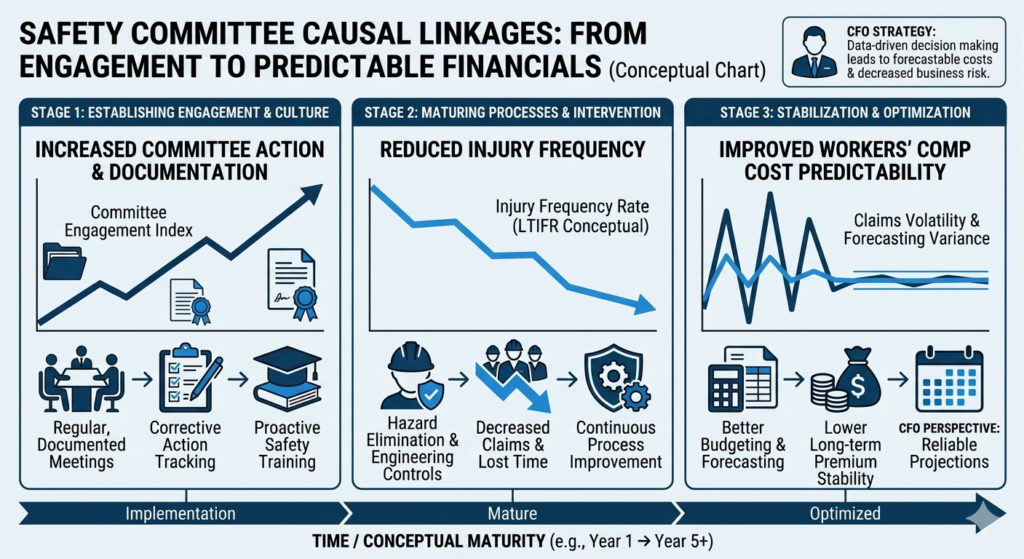
The long-term benefits tend to be in the form of indirect cost savings but are much more significant to your bottom line. Depending on how effectively the committee operates, potential long-term benefits may include:
- Fewer injuries and insurance claims
- Less severe injuries
- Faster recovery times
- Fewer or shorter-duration lost-time injuries
- Decreased recruiting and hiring costs
- Stable, predictable, and lower insurance costs
- Improved brand reputation
- Healthier and happier workforce
- More accurate budgeting and forecasting
- Improved cash flow
- Improved hazard controls, documentation, and OSHA recordkeeping
At Stillwell Risk Partners, we’ve developed a guide to implementation of a PA Workplace Safety Committee, which you can find here.
Best Practices for Long-Term Cost Reduction
Running effective meetings is a skill that involves making sure stakeholders are all in attendance and that communication between committee members – and to other employees – is accurate and consistent.
Here are some basics of how we recommend structuring your safety committee meetings:
- Tie the agenda to loss trends. Use claims, OSHA logs, near misses, and incident reports to prioritize committee work.
- Track leading indicators. Measure inspections completed, hazards reported, corrective actions closed on time, training completion, near-miss reports, and supervisor observations.
- Use near misses as free lessons. Data collected through near miss reporting helps you identify potential injuries before they happen.
- Require written management responses. Each recommendation should be accepted, modified, deferred, or declined with documented reasoning.
- Rotate inspection teams. Pair employees and management representatives, and rotate the areas they inspect to create fresh perspective.
- Connect findings to training. When repeated hazards appear, assign training and review whether job design, staffing, equipment, or supervision also need to change.
- Set annual safety goals. Examples include reducing lost-time claims, closing corrective actions faster, increasing hazard reporting, and reducing repeat findings.
- Use documentation with underwriters. Clean safety committee records can support the story that the business manages risk better than average.
- Evaluate whether corrective actions worked. After a fix is implemented, follow up to determine whether the hazard was actually reduced.
Using these as guidelines for setting your agenda will help you run custom and repeatable meetings that are focused on impact, as opposed to box-checking.
Who Should Serve on the Committee?
One common mistake I see is limiting committee members to employer representation, including senior management or leadership levels. This is a mistake because employee representation is vital to the effectiveness of a safety program.
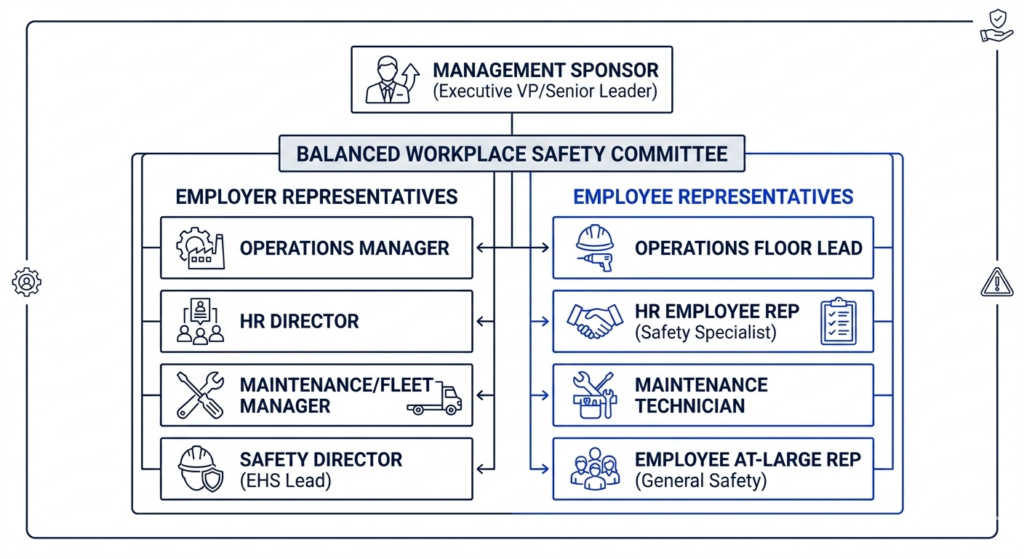
A committee should be comprised of at least 4 people, but depending on the size of your organization, it may be worth having more members. The seats on the committee should
include at least two employer and two employee representatives.
Pennsylvania’s Certification mandates that Employer Representation cannot outnumber Employee Representation. Employee Representation can outnumber Employer Representation.
The employees working the floor – the people who are most likely to be injured – are also most able to help identify hazards and prevent injuries. They also recognize whether or not they’re valued and taken seriously.
Employee representation helps avoid the perception (warranted or not) that management is detached from day-to-day operations and simply passes down edicts from on high without regard to what employees may legitimately feel are important factors to staying safe.
Having employee representation shows a commitment of resources by management and importantly, helps reinforce communications from management. Employee representation provides employees with visibility into the progress made over time, again making initiatives more effective.
Next Steps
Forming and implementing a safety committee is a project and should be managed as such. Our free white paper goes into detail about what the process entails, as well as links to other online resources.
At Stillwell Risk Partners, we help our clients plan and implement safety committees. If you’re interested in learning more, please book time for an intro call and we’ll be happy to answer your questions and explain the process in more detail.
Interested in other prevention first resources we offer at no cost?? Find out more about:
Frequently Asked Questions About Pennsylvania Workplace Safety Committees
A certified workplace safety committee is an employer-established committee that satisfies requirements established by the Pennsylvania Department of Labor & Industry. Certification must be renewed annually for the committee to remain in the program.
Qualifying insured employers with an approved workplace safety committee are eligible for an annual 5% workers’ compensation premium discount. The insurer calculates and applies the discount at the policy renewal following certification approval.
Self-insured employers may apply for workplace safety committee certification, but they are not eligible for the 5% insurance premium discount. Certification may still provide operational and risk-management benefits.
A certified committee must have at least four members: two employer representatives and two employee representatives. Employer representatives cannot outnumber employee representatives, although employee representatives may outnumber employer representatives.
The committee must meet at least monthly. A quorum—more than half of the official committee members—must attend each qualifying meeting.
The committee must operate in accordance with the certification requirements for at least six full consecutive calendar months before the initial application is submitted. Because the application deadline is at least 30 days before the workers’ compensation renewal, employers should generally establish the committee at least seven full months before renewal.
An initial application must be submitted through WCAIS between 90 and 30 calendar days before the workers’ compensation policy renewal date. Renewal applications must be submitted annually between 90 and 15 days before the policy renewal.
Every committee member must receive annual training from a qualified provider. The required subjects include safety committee operation, hazard detection and inspection, incident investigation and prevention, and substance abuse and opioid painkiller use.
The committee must maintain meeting agendas, attendance records, and meeting minutes for five years. Employers should also document inspections, incident reviews, recommendations, corrective actions, and management responses.
No. Certification and regular meetings create a useful structure, but results depend on whether the committee identifies hazards, follows through on corrective actions, engages employees, and evaluates whether its recommendations worked.
Potentially. An effective committee can help identify hazards earlier, reduce repeat incidents, strengthen training, improve loss documentation, and demonstrate stronger risk management to insurance underwriters. Actual results depend on the employer’s operations and how consistently the committee’s recommendations are implemented.