

Legal Malpractice Insurance: What Law Firms Should Review Before Renewal
Legal Malpractice Insurance is expensive. The question that can often be overlooked is – where is the policy most expensive?
The policy premium is where the attention is naturally drawn. It’s right there on the declarations pages and in your books; however, the true cost of your policy is buried in the details of the policy.
This overview will provide insight into several common areas where the differences in policy language offered through various insurance carriers can make a big difference in the actual cost of your policy.
What Does “Professional Services” Cover?
How the services you provide are defined is the core of where you have coverage – and where you don’t. An insuring agreement might look like:
“We will pay on Your behalf those sums which You become legally obligated to pay as Damages because of any Claim made against You for a Wrongful Act.”
From here, we would need to find the definition of “Wrongful Act,” which would lead to a definition of “Professional Services.” Under the Professional Services definition, there is a range of what is included for coverage – here is where we start to understand what is and is not covered under a policy.
This is a key policy provision to review, especially in comparison with other policy forms. As an attorney, you’re familiar with how just a few added or subtracted words can affect how a contract works.
For example, will you be covered as an expert witness or for pro bono work? Or would these be excluded from coverage?
What Is a Consent-to-Settle Clause?
Protecting Your Reputation and Your Bottom Line
A consent-to-settle provision generally requires the insurer to obtain the law firm’s approval before settling a malpractice claim. This can be especially important when a settlement could imply wrongdoing, affect the firm’s reputation, or undermine client confidence.
That control may come with a financial tradeoff. If the insurer recommends a settlement and the firm refuses, a “hammer clause” may limit what the insurer will pay. Depending on the policy language, the firm could become responsible for some or all additional defense costs, settlements, or judgments incurred after rejecting the recommended settlement.
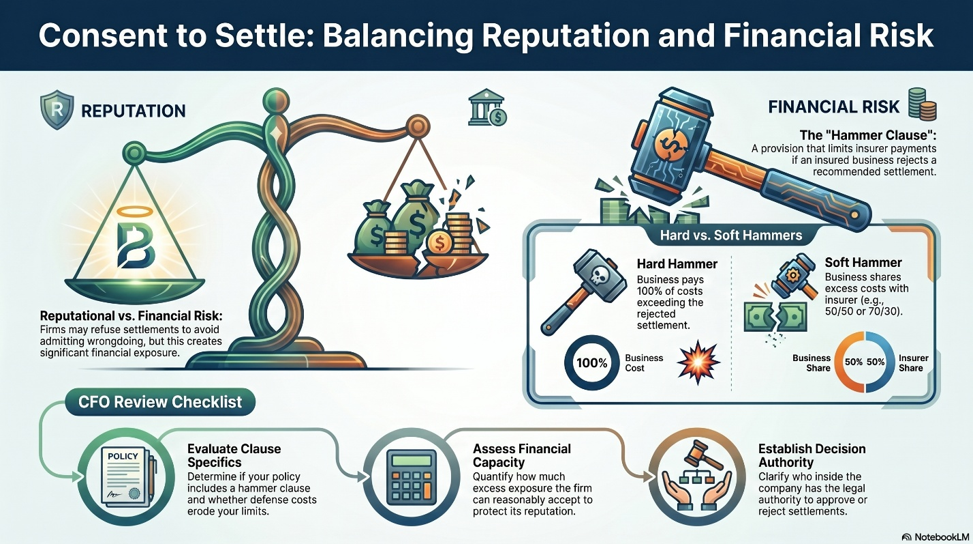
Hammer clauses can vary significantly. A hard hammer may cap the insurer’s responsibility at the amount for which the claim could have been settled. A soft hammer may divide the additional costs between the insurer and the firm using a stated percentage, such as 50/50, 70/30, or 80/20.
Before renewal, a law firm should review:
- Whether its consent is required before a claim can be settled
- Whether the policy contains a hard or soft hammer clause
- How additional costs are divided after the firm rejects a recommended settlement
- Who within the firm has authority to approve or reject a settlement
- Whether the potential financial exposure aligns with the firm’s risk tolerance
For law firms, the best provision is not necessarily the one offering the greatest control in isolation. The goal is to balance control over settlement decisions with the firm’s ability to absorb the resulting financial exposure. These terms should be understood during the renewal process—not discovered after litigation begins.
How Do Retroactive and Prior-and-Pending Dates Affect Coverage?
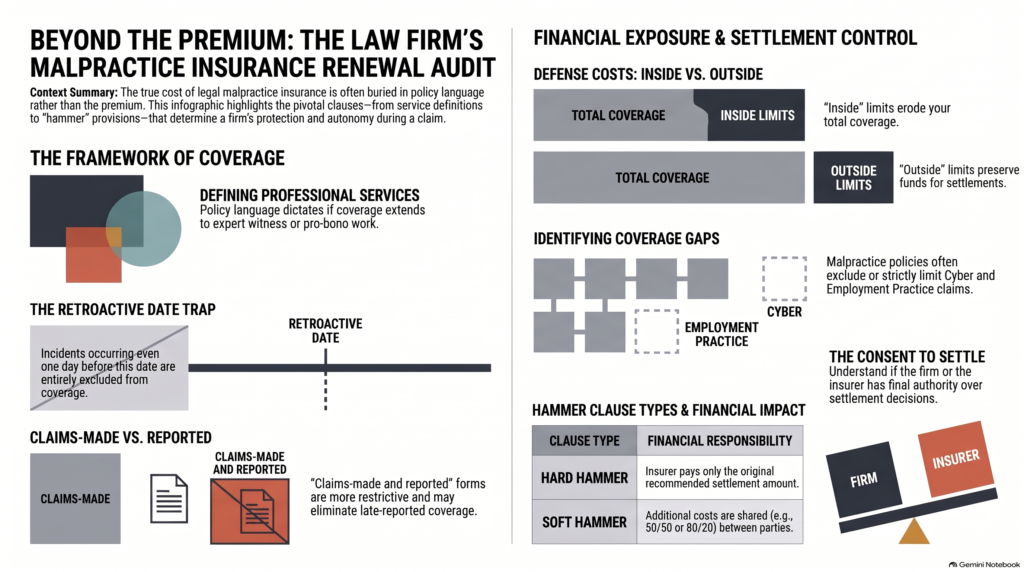
Malpractice policies are written on a claims-made form. This means that the Retroactive Date and Prior-and-Pending Litigation Date are vitally important to whether or not you actually have coverage.
First, identify whether your policy is on a “Claims-Made” or “Claims-Made and Reported” form. Here’s the difference:
A claims-made policy generally covers claims first made during the policy period, with reporting permitted according to the policy’s notice provisions. A claims-made-and-reported policy requires the claim to be both made against the insured and reported to the insurer within the policy period or a specified reporting window; late reporting may eliminate coverage.
Put simply, a claims-made form is often preferred over a claims-made and reported form, but it’s not guaranteed and therefore important to review the specific provisions.
How Retroactive and Prior-and-Pending Litigation Dates Affect Coverage
Lawyers professional liability policies are generally written on a claims-made basis, and many require a claim to be both made against the insured and reported to the insurer within a specified period. A claims-made policy may allow reporting according to broader notice provisions, while a claims-made-and-reported policy expressly requires both events to occur within the policy period or an applicable reporting window. The precise policy language controls.
The retroactive date and prior-and-pending litigation date serve different purposes. The retroactive date generally establishes the earliest date on which a covered wrongful act may have occurred. The prior-and-pending litigation date generally applies to claims arising from litigation, proceedings, or circumstances that existed before that date.
Continuous coverage is important, but it does not guarantee that a claim will be covered. The claim must also satisfy the policy’s reporting requirements, prior-knowledge provisions, definitions, exclusions, and other conditions.
For example, if a policy has an October 1, 2024 retroactive date, a wrongful act occurring on September 30, 2024 would generally fall outside the policy’s prior-acts coverage. An act occurring on or after October 1, 2024 clears that particular requirement but is not automatically covered; all other policy terms still apply.
Other Important Coverage Areas to Review
While there is more detail that we can go into here, your non-premium costs can rise or fall depending on where your policy stands in regard to:
- Are Defense Costs Inside or Outside the limit of coverage?
- Is there a separate or additional defense cost limit that provides additional coverage?
- What are your per claim and aggregate limits of coverage? Are these limits sufficient in a worst-case scenario? Do these match your firm’s appetite and capacity for risk?
- Do you have a Deductible or a Self-Insured Retention?
- Does this apply for damages only, or also for defense costs?
- Are claims based on a carrier’s Duty to Defend or will they only Indemnify you while you remain responsible for defense?
- Do you have any role in choosing Defense Counsel?
What Exclusions Should Law Firms Review?
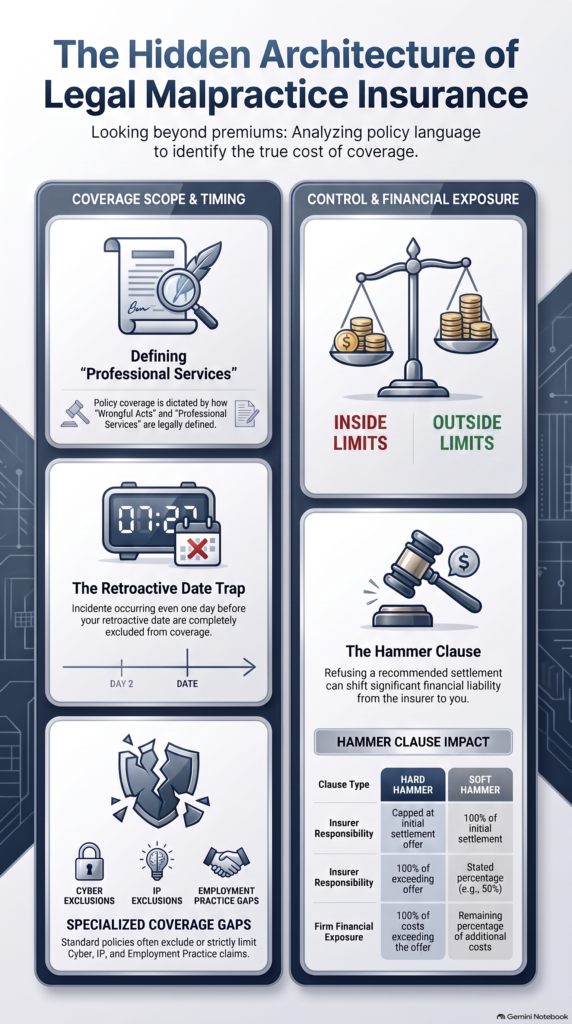
All insurance policies contain exclusions which limit your coverage. Some common exclusions we see in legal malpractice insurance include:
- Cyber and Privacy-Related Losses
Some Malpractice Policies include an option to include some limited Cyber coverages. Often, this coverage is limited to privacy liability and/or other limited coverages. In most cases, law firms need separate, stand-alone cyber insurance policies to cover a wider range of potential losses. - HR & Employment-Related Claims
Lawyers professional liability policies frequently exclude employment-related claims. Some provide a limited defense-cost sublimit, but separate Employment Practices Liability insurance may be necessary to cover wrongful termination, discrimination, harassment, and retaliation claims. - Other Exclusions
Exclusions vary by carrier, and some restrictions may appear in the definitions or insuring agreement rather than in the exclusion section itself. These might include:- Intentional, Dishonest, Fraudulent, Criminal, or Malicious Conduct
- Prior Knowledge or Known Circumstances
- Prior or Pending Claims and Litigation
- Bodily Injury and Property Damage
- Contractual Liability
- Insured Versus Insured
- Related Entities and Business Enterprises
- Discrimination, Harassment, and Sexual Misconduct
- Client Funds and Trust Accounts
- False-Pretense and Fraudulent-Transfer Losses
- Investment, Securities, and Financial Advice
- Services Outside the Definition of Professional Services
- Intellectual Property and Technology
- Title-Insurance Activities
- Public-Official or Government-Employee Capacity
- Services for Family Members or Related Persons
- Correcting or Reperforming Professional Services
- Fines, Penalties, and Sanctions
- Punitive, Exemplary, or Multiplied Damages
- Disciplinary and Regulatory Proceedings
- Economic and Trade Sanctions
What Risk Management Resources Are Available?
Many insurance carriers and some brokers offer additional risk management resources that can help prevent claims. These might be things you’re paying for separately that you might be able to get for free – or at a reduced cost.
Leveraging your insurance coverage in this way can help reduce your expenses in ways you might not expect.
Make sure to review your policy and any proposals you might receive to find out what resources you might have available. These might include:
- Templates, forms, agreements, engagement letters and other contractual documents.
- Complimentary CLE courses
- Checklists to assist with screening new clients, opening new files, and screening for potential conflicts of interest
- Keeping you up to date on recent decisions regarding malpractice claims and ethics
- Risk Management Hotlines for discussing problems and questions with professionals who often have years of experience working in risk management with law firms.
- Human Resources management platforms
- Learning Management Systems
- Compliance Check Assessments
- Safety and Harassment Training
Next Steps
If your firm is reviewing your Malpractice insurance – whether or not your policy is coming up for renewal soon – Stillwell Risk Partners would love to be a resource for you!
The principals on which we’re founded include a dedication to providing education to the decision makers at law firms. Insurance is a confusing topic – consider us your translator so that you can make good decisions around your insurance program without having to go through formal insurance training!
Other Resources to Review
- More detail on the Consent to Settle / Hammer Clause
- Why AI use may create gaps in coverage
- Why firms need more than a basic business insurance package
- Law Firm Malpractice Renewal Checklist
Frequently Asked Questions About Legal Malpractice Insurance
A law firm should review the definition of professional services, retroactive date, reporting requirements, consent-to-settle provision, defense costs, limits, deductible or retention, defense arrangements, exclusions, and available risk management resources. Premium should be considered alongside these coverage terms rather than evaluated by itself.
Professional services are the activities the policy recognizes as covered legal or related services. Depending on the policy, this may include work performed as a lawyer, mediator, arbitrator, notary, trustee, expert witness, title agent, or in another specified capacity.
A consent-to-settle clause generally requires the insurer to obtain the law firm’s approval before settling a malpractice claim. If the firm rejects a recommended settlement, a hammer clause may shift some of the additional defense costs or damages back to the firm.
A claims-made policy generally covers claims first made during the policy period, subject to its notice requirements. A claims-made-and-reported policy requires the claim to be both made against the insured and reported to the insurer within the policy period or an applicable reporting window.
The retroactive date generally establishes the earliest date on which a covered wrongful act may have occurred. A claim involving professional services performed before that date will ordinarily fall outside the policy’s prior-acts coverage.
A prior-and-pending litigation date is generally used to exclude claims arising from litigation, proceedings, or related circumstances that existed before the stated date. It serves a different purpose from the policy’s retroactive date.
They often do. When defense costs are inside the limit, legal fees and related claim expenses reduce the amount remaining to pay a settlement or judgment; some policies instead provide defense costs outside the limit or offer additional defense-cost coverage.
Both require the law firm to absorb part of a covered loss, but a self-insured retention may have to be satisfied before the insurer’s payment obligations apply and may place additional claim-handling responsibilities on the firm. The specific policy language determines how either amount applies to damages and defense costs.
Coverage is often limited or excluded. A malpractice policy may provide incidental privacy liability or a small employment-practices defense sublimit, but law firms commonly need separate cyber and Employment Practices Liability policies for broader protection.
Common exclusions may address intentional or fraudulent conduct, prior knowledge, related entities, client funds, investment advice, employment practices, bodily injury, property damage, cyber events, and services outside the definition of professional services. Exclusions and their exceptions vary substantially among carriers and policy forms.